
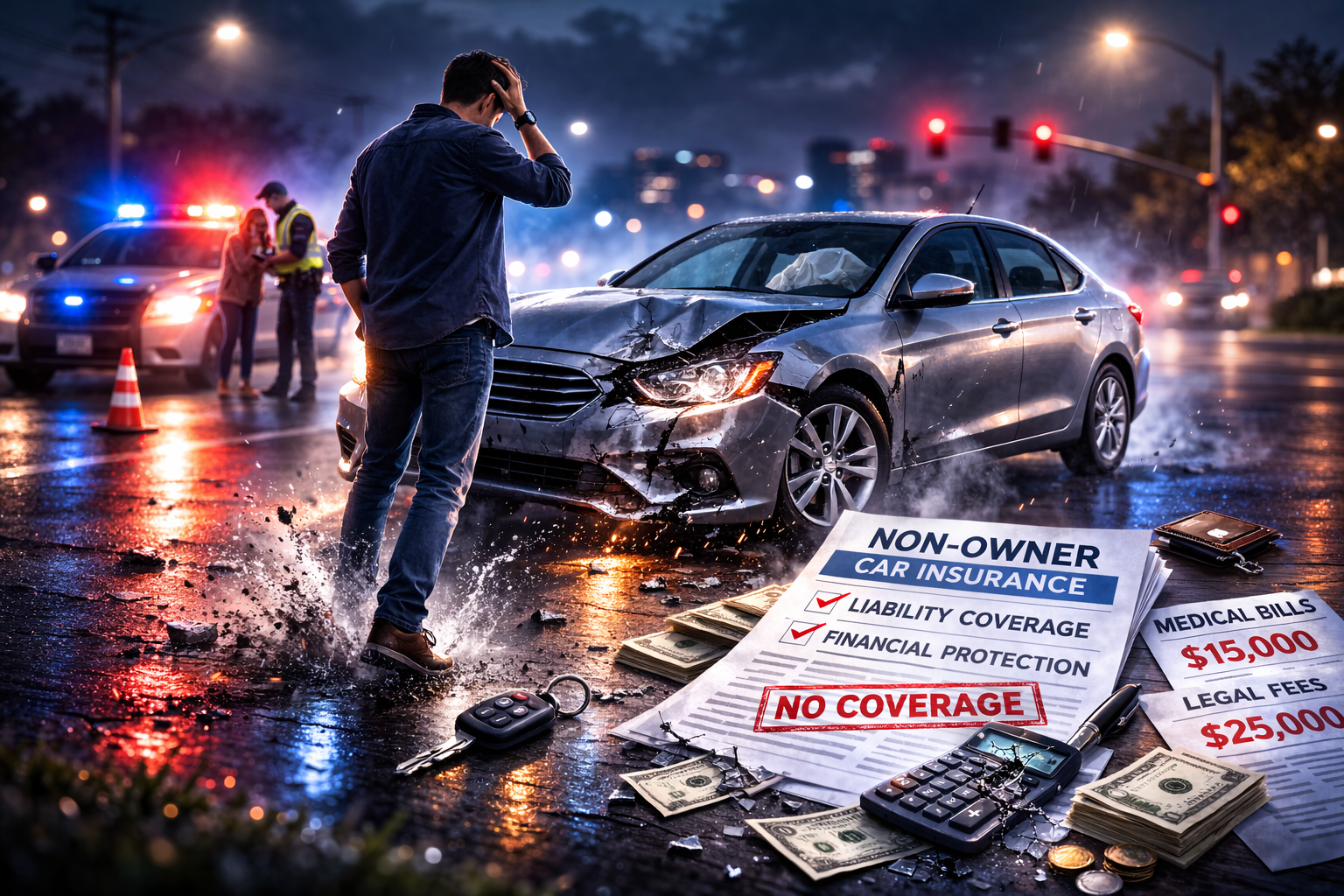


Introduction: The Assumption That Almost Cost Me Thousands
For years, I believed something that many occasional drivers believe:
“If I’m just borrowing a friend’s car, their insurance covers me.”
Technically? Sometimes yes.
Practically? Not always.
And that misunderstanding is exactly why non-owner car insurance exists.
In this article, we’re going deeper than the basics. We’ll break down:
• What really happens when you borrow a car
• Where liability actually falls
• How coverage gaps create financial risk
• Why non-owner insurance is often misunderstood
• Who needs it most in 2026
• And how to structure coverage properly
If you ever drive a vehicle you don’t own — this matters more than you think.
——————————————————————————
Section 1: How Car Insurance Actually Follows the Vehicle (Not You)
Most people think insurance follows the driver.
In reality, in the United States, auto insurance primarily follows the vehicle.
Here’s the simplified structure:
| Scenario | Whose Insurance Pays First? | Who Pays Second? |
|---|---|---|
| You crash your friend’s car | Friend’s policy | Your non-owner policy |
| You injure someone | Friend’s liability | Your excess liability |
| Property damage exceeds limits | Friend’s limits | You personally |
That last column is the danger zone.
If the damages exceed the owner’s liability limits and you do not have non-owner coverage, you can be personally sued for the difference.
That’s not theoretical.
It happens.
——————————————————————————
Section 2: Real Financial Exposure (Example Breakdown)
Let’s look at a realistic accident scenario:
• Medical bills: $85,000
• Property damage: $32,000
• Total liability: $117,000
Friend’s policy limits:
$50,000 bodily injury per person
$25,000 property damage
Shortfall:
$42,000 bodily injury
$7,000 property damage
Total out-of-pocket exposure: $49,000
Without non-owner insurance, that amount can become your personal liability.
Savings wiped out.
Wages garnished.
Assets at risk.
All from “just borrowing a car.”
——————————————————————————
Section 3: Who Actually Needs Non-Owner Insurance in 2026?
Non-owner car insurance isn’t for everyone — but it is critical for specific groups.
You likely need it if you:
✔ Frequently borrow friends’ or family members’ vehicles
✔ Rent cars regularly for business travel
✔ Use car-sharing platforms
✔ Need SR-22 or FR-44 filing
✔ Recently sold your car but still drive occasionally
✔ Want continuous insurance history
You likely don’t need it if:
✘ You never drive
✘ You are listed on the owner’s policy as a household driver
✘ You own a vehicle
——————————————————————————
Section 4: Continuous Coverage and Credit Impact
Here’s something many drivers overlook:
Insurance history affects your rates.
If you let coverage lapse, insurers may classify you as:
“Previously uninsured”
That can increase future premiums by 10%–40%.
Maintaining a low-cost non-owner policy keeps your insurance record active, which protects you when you eventually purchase a car again.
This is especially important in states with strict underwriting rules.
——————————————————————————
Section 5: State Law Differences
Coverage requirements vary widely by state.
For example:
• Some states require minimum liability only
• Others mandate higher bodily injury limits
• Some require SR-22 filings after violations
In certain states, driving uninsured — even occasionally — can lead to:
• License suspension
• Registration suspension
• Heavy reinstatement fees
• Mandatory high-risk insurance
Non-owner policies can satisfy legal proof-of-insurance requirements without vehicle ownership.
——————————————————————————
Section 6: What Non-Owner Insurance Does NOT Cover
This is critical.
Non-owner insurance typically does NOT include:
✘ Collision coverage
✘ Comprehensive coverage
✘ Vehicle repair for borrowed cars
✘ Coverage for vehicles you regularly access
✘ Commercial driving use
It is strictly liability-focused protection.
Think of it as financial damage control — not car repair insurance.
——————————————————————————
Section 7: Cost in 2026
Average annual cost:
$200 – $600 per year
Monthly range:
$18 – $50 per month
Factors that influence cost:
• Driving record
• State
• SR-22 requirement
• Age
• Credit profile
• Coverage limits
Compared to potential liability exposure, this is relatively inexpensive protection.
——————————————————————————
Section 8: Common Mistakes Drivers Make
Mistake 1: Assuming “permissive use” equals full protection
Mistake 2: Ignoring policy limit caps
Mistake 3: Not understanding excess liability structure
Mistake 4: Letting insurance history lapse
Mistake 5: Choosing state minimum limits only
State minimum limits are often insufficient in real-world accident scenarios.
Many experts recommend at least:
$100,000 bodily injury per person
$300,000 bodily injury per accident
$50,000 property damage
——————————————————————————
Section 9: Strategic Coverage Planning
If you borrow cars occasionally but want real protection:
Step 1: Confirm the owner’s policy limits
Step 2: Purchase non-owner coverage that exceeds those limits
Step 3: Consider umbrella insurance if you have assets
Step 4: Maintain continuous coverage
This layered structure reduces personal exposure significantly.
——————————————————————————
Conclusion: Small Premium, Massive Protection
Non-owner car insurance isn’t flashy.
It doesn’t repair vehicles.
It doesn’t come with roadside perks.
But it protects your financial future.
And for less than the cost of a streaming subscription, it can prevent five-figure liability exposure.
If you ever drive a vehicle you don’t own — even occasionally — it’s worth evaluating.
Because the biggest insurance risks aren’t the ones you expect.
They’re the ones you assume are covered.

Leave a Reply